
If you have ever asked a managed IT provider what they actually watch on your network, the answer should be longer than ‘everything.’ Fresno businesses face the same automated attack landscape as companies in San Francisco or Los Angeles, and a cybersecurity provider that cannot name its monitoring layers in plain language is one you should not trust with your network.
RealTime CA works with Fresno organizations ranging from healthcare clinics to agricultural operations, and we hear the same question regularly: what does managed monitoring actually cover? This guide breaks down the six core domains that every credible cybersecurity provider in Fresno should monitor, backed by the data that explains why each one matters.
Last updated: [Month Day, Year]
Key Takeaways
- A credible Fresno cybersecurity provider monitors at least six distinct layers: networks and servers, endpoints, identity and access, cloud platforms, security operations, and backup integrity.
- Downtime from a mid-market cyber incident averages $356,000 per day in 2025, not counting ransom payments or legal fees, which means monitoring is a financial decision as much as a technical one.
- Monitoring generates alerts, but a SOC or MDR service is what turns those alerts into containment actions before a small incident becomes a business-threatening outage.
- Organizations that maintained offline backups cut ransomware recovery costs by 44% compared to those that paid the ransom demand, making BCDR monitoring one of the highest-ROI controls available.
Why Fresno Businesses Are Prime Targets for Automated Attacks
Fresno’s economy spans healthcare, agriculture, distribution, education, and professional services, and each of those sectors handles sensitive data that attackers treat as inventory. The Central Valley concentration of mid-market businesses also means fewer in-house security teams and a higher proportion of organizations that depend on external providers for their protection.
FortiGuard Labs recorded over 36,000 automated reconnaissance scans per second globally in 2024, a 16.7% year-over-year increase . Attackers are not hand-picking Fresno businesses; they scan every internet-connected system continuously, which means that being a regional SMB offers zero protection from automated exploitation
.
A managed cybersecurity provider in Fresno earns its retainer by watching the right signals at the right depth, around the clock. The sections below explain exactly what those signals are, why each monitoring layer exists, and what the documented cost is when one is missing.
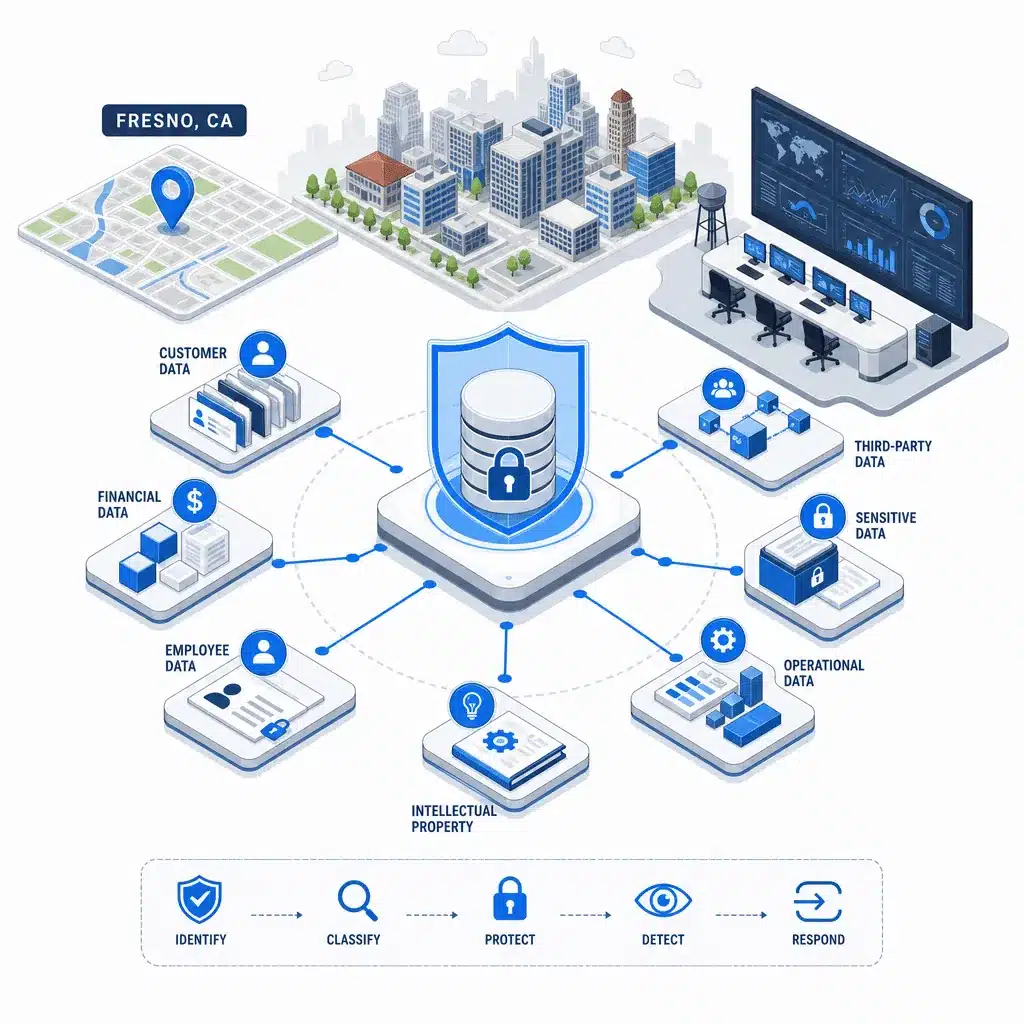
Managed Cybersecurity Monitoring: Key Stats for Fresno Businesses (2025)
Sources: Fortinet 2025 Global Threat Landscape Report (FortiGuard Labs); Sophos Quantifying ROI Report, February 2025; industry downtime cost benchmarks for mid-market organizations.
24/7 Network and Server Monitoring: The First Line of Visibility
Network and server monitoring is the foundation of a managed security program. Real monitoring means surfacing meaningful alerts, not forwarding every log line to a dashboard that no one reviews, and it includes scheduled maintenance windows, firmware update verification, and clean rollback capability when something misbehaves.
Downtime costs for mid-market companies now average $356,000 per day in 2025, excluding ransom payments, legal fees, and reputational damage. When a firmware update fails at 2 a.m.
or a misconfigured firewall rule opens an unintended port, the provider monitoring your network should catch it before the morning shift arrives.
Firewall rule audits, bandwidth anomaly detection, and server health thresholds are not optional extras; they are the baseline that separates proactive management from reactive break-fix support. A Fresno business that reviews its network posture monthly rather than continuously is effectively unprotected during the 99% of time between those reviews.
Ask any prospective provider how many meaningful alerts, not raw log events, they investigated on behalf of a client last month. A provider that cannot answer that question with specifics is not running an active monitoring program.
Endpoint Security: EDR, Patch Management, and Encryption
Every laptop, workstation, mobile device, and server is an endpoint, and each one is a potential entry point for ransomware or credential theft. Legacy antivirus compares files against a signature database and misses threats that have not yet been catalogued; credible providers deploy EDR (Endpoint Detection and Response) agents that monitor real-time process behavior and flag activity that matches known attack techniques.
Threat actors constantly refine their delivery methods, and one recent evolution shows how a Malware Virus Now Targets USB Devices to bypass network-based defenses entirely.
Ransomware incidents involve smaller businesses in 88% of cases, and recovering from a single attack averages $1.53 million excluding the ransom payment itself . Fresno healthcare clinics, law firms, and school districts are exactly the organizations ransomware groups target because they hold sensitive data and often run on constrained security budgets
.
Patch management is the least exciting part of endpoint security, but unpatched software remains the most reliable and commonly exploited attack surface available to threat actors. A provider that automates patch deployment and tracks compliance across every managed device removes one of the most consistent entry vectors before it can be used against a Fresno client.
Full-disk encryption on every endpoint closes the physical theft vector, which matters in industries where laptops leave the office. Monitoring encryption status as part of the managed service ensures that a new device does not sit unencrypted for three weeks because someone forgot to run the onboarding script.

Identity, Access Management, and MFA Activity Monitoring
Monitoring who logs in, from where, at what time, and on which device is one of the highest-value activities a managed cybersecurity provider can perform. Attackers who obtain valid credentials do not need to exploit a vulnerability; they authenticate normally and spend weeks moving through a network before detection.
The Fortinet 2025 Global Threat Landscape Report documented a 42% year-over-year surge in stolen credentials shared on darknet forums, with over 100 billion compromised records in circulation by the end of 2024. When those credentials belong to a Fresno employee who reused a password across personal and work accounts, only active monitoring of login patterns and MFA activity can catch the intrusion before it escalates.
Practical identity monitoring includes alerting on logins from geographic locations that are impossible given recent activity, detecting MFA push fatigue attacks, and flagging dormant accounts that suddenly become active outside of business hours. A provider that watches only the perimeter while ignoring access patterns inside the environment will miss the majority of modern intrusion techniques.
Conditional access policies, privileged access reviews, and service account audits are the identity-layer controls that monitoring should enforce and verify continuously. If your provider cannot tell you which accounts in your environment have administrative privileges and when those accounts last authenticated, there is a blind spot that credential-based attackers will find.
Cloud and SaaS Platform Monitoring: Microsoft 365, Google Workspace, and Beyond
Most Fresno businesses now run significant workloads in Microsoft 365, Google Workspace, or other cloud platforms, and each of those environments has its own attack surface that is entirely separate from the on-premises network. Monitoring a Microsoft 365 tenant means watching Exchange Online for unauthorized mail forwarding rules, SharePoint for unusual bulk downloads, and Teams for credential phishing attempts inside the platform itself.
Leading Fresno providers offer continuous monitoring of M365 tenants alongside endpoint and firewall coverage, treating cloud platforms as an integrated part of the security program rather than a separate IT function managed by a different team. Cloud misconfigurations and over-permissioned service accounts are among the most consistent causes of serious data breaches, and they are invisible to a provider that only monitors on-premises infrastructure.
Always-on MDR coverage that spans endpoints, Microsoft 365, and firewalls within a single unified view is the baseline expectation for a credible provider in 2025, not a premium add-on tier. If a prospective Fresno provider cannot show you a unified dashboard that includes your cloud tenant activity, ask them where that coverage gap is addressed in their service agreement.
SaaS backup is a separate and commonly overlooked component: Microsoft and Google do not guarantee recovery from user error, ransomware propagation into cloud storage, or malicious deletion by a compromised account. Cloud-to-cloud backup monitoring ensures that your M365 and Google Workspace data has a separate, recoverable copy that is independent of the primary tenant.
Managed Detection and Response (MDR) and SOC Services
Monitoring generates alerts; a Security Operations Center (SOC) or MDR service is what turns those alerts into investigated incidents and containment actions. Providers like RealTime CA run or integrate with a SOC specifically to deliver real-time threat visibility and fast incident containment for Fresno businesses that cannot staff their own 24-hour security operations team.
The financial case for MDR is documented: organizations using MDR report filing 97.5% less on cyber insurance claims than organizations that rely on endpoint protection alone, according to the Sophos Quantifying ROI Report published in February 2025 . That figure represents a structural reduction in loss events, not simply a discount on an insurance premium
.
Sophos MDR resolves 52% of detected threat cases end-to-end through AI in an average of 89 seconds, with human analysts supervising every AI decision and owning every outcome. For a Fresno business without a dedicated security team, an MDR service delivers that response speed and analyst expertise at a fraction of the cost of hiring and retaining in-house SOC staff.
When evaluating a Fresno cybersecurity provider, ask specifically whether their SOC is staffed around the clock or whether alerts queue until the next business day. An after-hours alert that waits until 8 a.m.
for a human to review it is not a SOC; it is a logging service.
Backup Monitoring, BCDR Planning, and Ransomware Recovery Readiness
Backup monitoring is not simply confirming that a nightly job completed without an error code. A credible provider tests restores against documented recovery time objectives, validates backup integrity across retention periods, and maintains immutable or offline copies that ransomware cannot reach and encrypt after compromising the primary environment.
The average ransomware disruption lasts 24 days before full operational restoration, and downtime costs routinely exceed the ransom payment itself by a factor of two or more. Organizations that maintained offline backups before an attack cut their total recovery costs by 44% compared to organizations that ended up paying the ransom demand.
Business continuity and disaster recovery (BCDR) planning closes the gap between ‘our backups ran last night’ and ‘we can restore critical systems in four hours.’ Fresno businesses in healthcare, agriculture, and financial services cannot absorb a three-week outage, and a provider that monitors backup health, tests recovery runbooks, and maintains documented escalation procedures is the difference between a contained incident and a business-threatening failure.
Immutable backups, cloud-to-cloud SaaS backup, and tested disaster recovery plans with documented RTO and RPO metrics are the components that make backup monitoring a genuine recovery capability rather than a compliance checkbox. Ask your current or prospective provider for the date and result of their most recent live restore test on a production system.
Frequently Asked Questions
What does a managed cybersecurity provider in Fresno actually monitor on a daily basis?
A credible provider monitors network traffic and server health, endpoint process behavior via EDR agents, user login patterns and MFA activity, cloud platform events in Microsoft 365 or Google Workspace, firewall logs, and backup job status and integrity. The most capable providers route all of that telemetry through a SOC or MDR service that investigates alerts and contains threats in real time rather than simply logging them for a monthly report.
How is EDR different from traditional antivirus software?
Antivirus software compares files against a database of known malware signatures and misses threats that have not yet been catalogued or that use fileless attack techniques. EDR monitors what every process on a device actually does, including which files it touches, which network connections it opens, and whether its behavior matches known attack patterns, giving security teams the ability to detect and stop threats that bypass signature-based tools entirely.
Why do attackers go after Fresno SMBs when there are larger companies available?
Most SMB attacks are not hand-targeted; automated tools scan every internet-connected system continuously and flag organizations with exploitable configurations or unpatched software. Ransomware groups specifically favor organizations with valuable data and limited security resources, and many Fresno healthcare practices, law firms, and agricultural operations fit that profile exactly.
Does MFA alone protect business accounts from credential theft?
MFA is an essential control, but attackers have developed reliable bypass methods including SIM swapping, adversary-in-the-middle phishing kits that harvest session tokens in real time, and MFA push fatigue attacks that trick users into approving fraudulent login requests. Active monitoring of login anomalies, impossible-travel alerts, and MFA event logs is what catches compromised accounts that MFA alone would have missed.
What should I ask a Fresno cybersecurity provider before signing a managed security contract?
Ask whether their SOC is staffed 24 hours a day or whether alerts go unreviewed after business hours, and ask for documented proof of how frequently backup restore tests are performed on production systems. Request specifics on mean time to detect and mean time to respond, ask for a verifiable client reference from your industry, and confirm that cloud platform monitoring for Microsoft 365 or Google Workspace is included in the base service tier rather than a separate add-on.
What is the difference between MDR and a managed firewall service?
A managed firewall blocks known threats at the network perimeter based on rules and signatures but does not investigate behavior on endpoints, inside cloud platforms, or across user identity activity. MDR combines AI-driven detection technology with human analysts who hunt for threats across all of those surfaces, investigate suspicious behavior in context, and take active containment steps, making it a security operations service rather than a single-point perimeter tool.

About the author
Ajaz Ahmed - CEO / President
Ajaz Ahmed is the CEO/President of Real Time Information Services, Inc., a Fresno, California managed IT services company founded in 1992 that supports small and mid-sized businesses across the Central Valley. He guides the company's vision, strategy, and overall growth.
Recent Comments