
Discovering your network has been hacked triggers immediate pressure to act, but the wrong first move can destroy evidence or make recovery harder. Fresno businesses face the same threats as larger metros, with fewer internal resources to absorb the shock.
This checklist walks through the critical first hours after a breach, from containment through notification, so you can protect operations, preserve forensic value, and start recovery with confidence.
Key Takeaways
- Disconnect compromised systems from the network immediately, but do not power them off, volatile memory holds evidence that investigators need.
- Document every action with timestamps, including who discovered the breach, what systems showed symptoms, and what steps you took before help arrived.
- Notify your cyber insurance carrier and legal counsel before contacting outside IT help, premature disclosure can void coverage or create liability.
- Preserve logs from firewalls, servers, and endpoint tools; these are often overwritten automatically and represent your best chance to trace the attacker’s path.
First Response in the Critical First Hour
The hour after discovering a network intrusion is the most consequential for both containment and future investigation. Your instinct may be to shut everything down, but powered-off systems lose volatile memory that forensic analysts use to identify malware, extract encryption keys, and trace attacker movement.
Instead, isolate affected machines at the network level: unplug Ethernet cables, disable Wi-Fi, or segment VLANs so the device cannot communicate outward while remaining powered on. Document the exact time of isolation and who performed it, this becomes part of your incident timeline.
If you cannot isolate individual machines quickly, consider a broader network segmentation move at the switch or firewall level. The goal is to stop lateral movement without alerting the attacker that you have detected them, which could trigger destructive actions like ransomware deployment or data wiping.
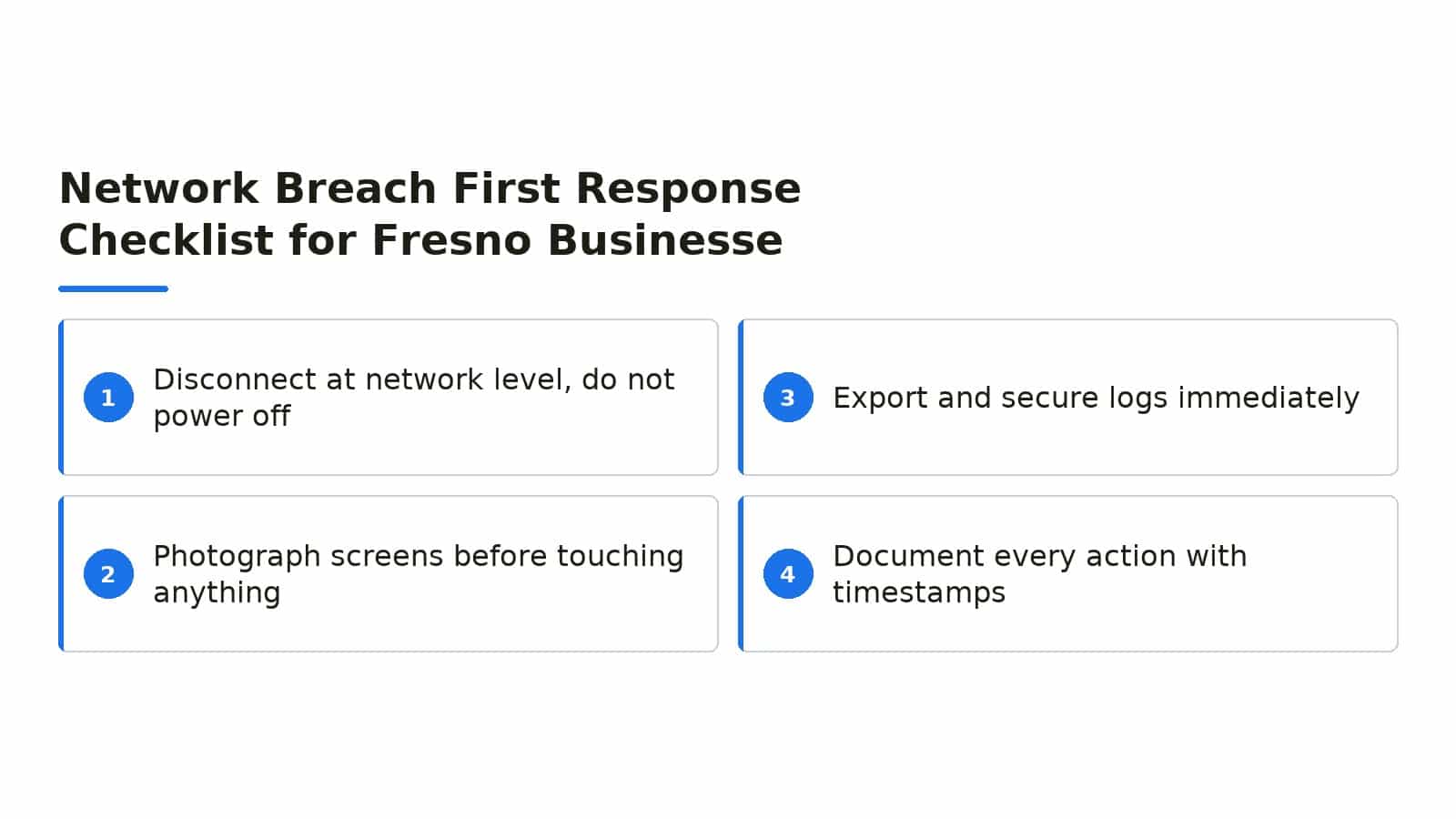
Network Breach First Response Checklist for Fresno Businesses
- ✓Disconnect at network level, do not power off: Isolate compromised systems by unplugging Ethernet or disabling Wi-Fi while preserving volatile memory
- ✓Photograph screens before touching anything: Capture ransom notes, error messages, and unusual activity to establish discovery state
- ✓Export and secure logs immediately: Firewall, Active Directory, endpoint, and mail logs before automatic overwrite or attacker deletion
- ✓Notify cyber insurance carrier first: Call your insurer’s breach hotline before outside IT vendors to preserve coverage and coordinate response
- ✓Contact legal counsel familiar with breach law: California Civil Code Section 1798.82 and HIPAA impose specific notification timelines and penalties
- ✓Force password resets on privileged accounts: Implement temporary authentication changes without full operational shutdown
- ✓Require multi-factor authentication on admin portals: Add friction for attacker persistence while maintaining business continuity
- ✓Verify backup immutability before any recovery attempt: Confirm air-gapped or write-once backups are intact before rebuilding from potentially compromised sources
- ✓Document every action with timestamps: Create an incident timeline including who, what, and when for forensic and legal purposes
- ✓Engage certified incident response support: Remote and on-site expertise with documented compliance experience for your industry
This checklist reflects standard incident response practice and California legal requirements. Adapt based on your specific industry regulations and insurance policy terms.
Preserving Evidence Without Destroying It
Evidence preservation sounds like a secondary concern when systems are down and revenue is bleeding, but it directly affects your ability to recover, prosecute, or file insurance claims. Modern attackers understand this and often deploy anti-forensic tools that corrupt logs or overwrite deleted files after detection.
Before touching any system, capture a photograph of the screen showing error messages, ransom notes, or unusual activity. These images establish the state of the system at discovery and may reveal attacker identifiers like wallet addresses or contact emails that change later.
Next, secure your logging infrastructure: export firewall logs, Active Directory authentication logs, endpoint detection logs, and mail server logs to write-once media or a segregated storage account. Default retention periods on many devices range from 7 to 30 days, and attackers frequently target log repositories for deletion once they gain administrative access.
Activating Your Incident Response Team and Partners
Most Fresno businesses do not maintain a full internal incident response team, which makes knowing who to call, and in what order, a critical part of preparedness. Your cyber insurance policy likely specifies a preferred forensic firm and requires notification within a defined window, often 24 to 72 hours from discovery.
Contact your insurance carrier’s hotline first, they will assign a breach coach or legal liaison who coordinates forensics, notification requirements, and public relations. Calling an outside IT vendor before this step can complicate coverage if the vendor’s actions are later deemed to have worsened the damage.
If you do not have cyber insurance, your next call should be to legal counsel familiar with data breach notification laws. California’s data breach notification statute requires businesses to notify affected residents without unreasonable delay, and specific industries face additional federal requirements.

Understanding California and Federal Notification Requirements
California Civil Code Section 1798.82 requires any business that owns or licenses computerized data including personal information to disclose any breach of the security of the system following discovery or notification of the breach to any California resident whose unencrypted personal information was acquired by an unauthorized person. The disclosure must be made in the most expedient time possible and without unreasonable delay.
For healthcare organizations in Fresno, HIPAA breach notification rules add a 60-day window to notify affected individuals and specific timelines for reporting to the Secretary of Health and Human Services and prominent media outlets when breaches affect more than 500 residents of a state or jurisdiction. The California Attorney General also receives direct notification for breaches affecting more than 500 California residents.
Manufacturers, agricultural operations with employee records, and professional service firms holding client financial data all trigger these obligations. Failure to comply exposes the business to civil penalties and private litigation, so legal guidance during the first 48 hours is not optional.

Containment Strategies That Limit Business Disruption
Full network shutdown stops the attacker but also halts revenue, payroll, and customer service. A more surgical approach prioritizes containment of crown jewel systems, financial data, active directory infrastructure, and client databases, while allowing less critical operations to continue under enhanced monitoring.
Implement temporary authentication changes: force password resets for privileged accounts, disable remote access for non-essential users, and require multi-factor authentication on all administrative portals. These steps increase friction for the attacker without requiring complete operational shutdown.
If ransomware is present and encryption has begun, your backup strategy becomes the decisive factor. Organizations with immutable, air-gapped backups recover in hours rather than weeks.
Those relying on standard cloud sync or local disk backups often find those repositories encrypted as well, because modern ransomware actively hunts for backup targets.

How Real Time Information Services Supports Fresno Businesses After a Breach
Our team includes engineers with Microsoft, Cisco, and VMware certifications, many of whom are local graduates of California State University Fresno who understand the Central Valley business environment.
We deliver comprehensive incident response assistance including forensic preservation, log analysis, containment architecture, and recovery planning. Over 90% of issues are fixed remotely, and on-site engineers deploy the same business day when physical presence is required.
Our security risk assessment and management services evaluate cybersecurity risks, vulnerabilities, and compliance requirements with particular depth for healthcare organizations navigating HIPAA obligations. We also provide 24x7x365 threat management and proactive monitoring to identify and address threats before they impact operations.
For businesses seeking predictable costs, our fully managed services include end-user support, infrastructure management, cybersecurity, strategic planning, and technology lifecycle management. We operate with flat-rate, no-surprise billing through one predictable monthly invoice, so post-incident recovery does not generate unexpected project fees.
Frequently Asked Questions
How long do I have to notify customers after a data breach in California?
California law requires disclosure without unreasonable delay after discovery of a breach affecting unencrypted personal information. Healthcare organizations face additional HIPAA deadlines, typically 60 days to notify individuals and specific timelines for regulatory reporting.
Should I pay the ransom if my Fresno business is hit with ransomware?
Your decision should be made with legal counsel, your insurance carrier, and a qualified incident response team, not in isolation.
What is the most common mistake businesses make in the first hour after discovering a breach?
The most common mistake is powering off compromised systems, which destroys volatile memory containing forensic evidence. The correct first step is network isolation while keeping systems running, then documenting everything before calling for help.
Does my small Fresno business really need cyber insurance?
Small and medium businesses are increasingly targeted because attackers assume weaker defenses, and the cost of recovery often exceeds what an uninsured business can absorb. Cyber insurance covers forensic investigation, legal guidance, notification costs, and business interruption, making it a prudent risk transfer mechanism.
How can I tell if a breach is ongoing or if the attacker has already left?
Signs of an ongoing breach include continued data exfiltration, new account creation, authentication attempts from unusual locations, and persistence mechanisms like scheduled tasks or modified registry keys. A qualified security team uses endpoint detection, network traffic analysis, and log correlation to distinguish active intrusion from past compromise.

About the author
Ajaz Ahmed - CEO / President
Ajaz Ahmed is the CEO/President of Real Time Information Services, Inc., a Fresno, California managed IT services company founded in 1992 that supports small and mid-sized businesses across the Central Valley. He guides the company's vision, strategy, and overall growth.
Recent Comments