
When the security of this network has been compromised, every minute counts. Fresno businesses face the same sophisticated threats as larger metro areas, but often with smaller IT teams and tighter budgets that make rapid response even more critical.
This checklist walks through the immediate steps to contain damage, preserve evidence, and begin recovery. It is written for business owners, practice managers, and operations leaders who need clarity under pressure, not jargon.
Key Takeaways
- Disconnect affected systems from the network immediately to prevent lateral movement by threat actors.
- Preserve logs and forensic evidence before any cleanup begins; this supports both recovery and potential law enforcement reporting.
- Notify your IT partner or managed service provider within the first hour to activate incident response protocols.
- Document every action taken during the first 24 hours; this timeline becomes essential for insurance claims and regulatory reporting.
Recognizing the signs that the security of this network has been compromised
The first challenge is knowing an incident has occurred at all. Ransomware announces itself with encrypted files and payment demands, but many breaches stay quiet for weeks or months while attackers exfiltrate data or establish persistence.
Common indicators include unexpected software installations, new administrator accounts, outbound traffic spikes during off-hours, and alerts from endpoint protection tools. Employees may also report slow systems, frequent crashes, or strange emails sent from their accounts without their knowledge.
Phishing remains the most frequent entry point for Fresno-area incidents. A single clicked link can deploy a remote access trojan that gives attackers a foothold to move laterally across servers, workstations, and cloud services.
Businesses in regulated industries such as healthcare and professional services face additional scrutiny. A compromised network involving protected health information or payment card data triggers specific breach notification requirements under federal and state law.
Network Security Compromise Response Checklist for Fresno Businesses
- ✓Isolate affected systems from the network: Disconnect Wi-Fi, unplug Ethernet, or disable adapters within minutes of detection
- ✓Preserve logs and forensic evidence: Capture firewall, endpoint, and cloud logs before any cleanup or restoration begins
- ✓Force password resets for all accounts: Start with privileged administrators, then users, then service accounts
- ✓Enable multi-factor authentication everywhere: Block re-entry using credentials that may already be compromised
- ✓Contact your IT provider immediately: Activate incident response protocols and document every action taken
- ✓Restore from verified clean backups: Confirm backup integrity and test in isolation before reconnecting to production
- ✓Patch all systems and remove unsupported software: Close the vulnerabilities most commonly used for re-entry after incidents
- ✓Conduct a post-incident security assessment: Review policies, controls, and compliance posture to prevent recurrence
This checklist reflects current best practices for incident response. Specific regulatory requirements may vary by industry and should be confirmed with qualified legal counsel.

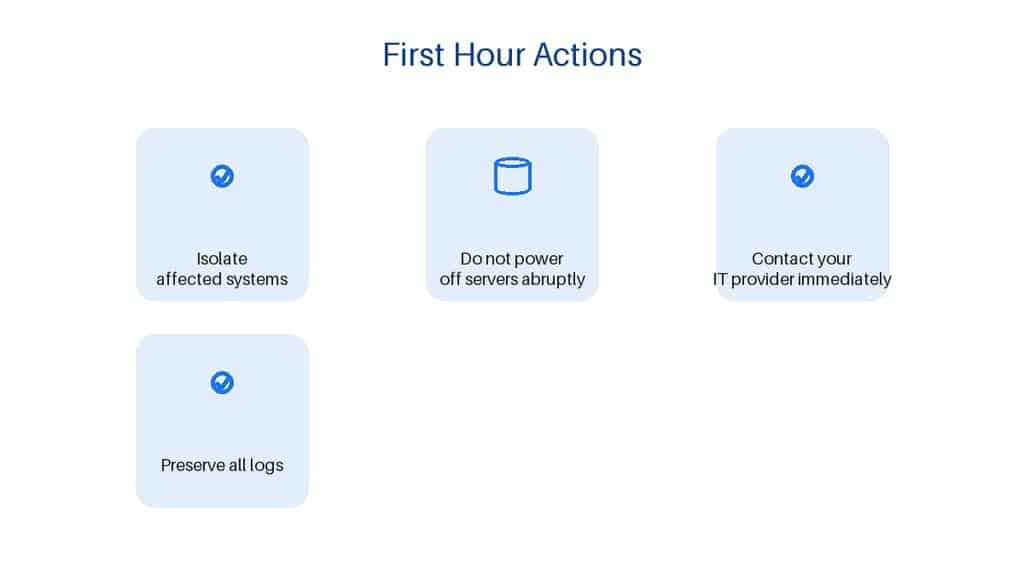
First hour actions to contain a network security incident
The moment you suspect the security of this network has been compromised, isolate affected systems. Disconnect from Wi-Fi, unplug Ethernet cables, or disable network adapters on individual machines.
Do not power off servers abruptly, as this can destroy volatile memory that contains forensic evidence.
Contact your IT provider immediately. A certified technician can guide containment remotely or dispatch an on-site engineer the same business day.
Preserve all logs from firewalls, switches, endpoints, and cloud services before any cleanup. These records show how the attacker entered, what they touched, and whether they still maintain access through backdoors or compromised credentials.
Alert key personnel including legal counsel, insurance contacts, and compliance officers. Early coordination prevents contradictory public statements and ensures regulatory timelines are met.
Securing accounts and credentials after a compromise
Assume every password in the environment is compromised. Force resets for all administrator accounts first, then standard user accounts, then service accounts.
Prioritize privileged access because attackers routinely target domain administrators and cloud tenant global admins.
Enable multi-factor authentication on every account that supports it, especially remote access, email, and cloud administration portals. MFA is not retroactive protection, but it blocks re-entry using stolen passwords that have not yet been changed.
Review recent sign-in logs for impossible travel, unfamiliar devices, and sessions from unexpected countries or IP ranges. Cloud platforms maintain 30 to 90 days of sign-in history that often reveals the original breach point and subsequent lateral movement.
Disable any accounts created during the incident and remove unauthorized email rules, forwarding addresses, or application permissions. Attackers frequently establish persistence through subtle configuration changes that survive initial password resets.
Assessing damage and planning recovery
Identify which data stores and systems were accessed, modified, or encrypted. This assessment drives recovery priority: patient scheduling systems for a Fresno clinic, inventory management for a manufacturer, or case files for a legal practice.
Determine whether sensitive data left the network. Exfiltration is harder to prove than encryption, but dark web monitoring and forensic analysis of outbound traffic can indicate what was taken.
This finding shapes breach notification obligations and legal risk.
Restore from clean backups that predate the compromise. Verify backup integrity before restoration begins, as attackers increasingly target backup systems to prevent recovery.
Maintain offline or immutable copies that cannot be reached from the production network.
Test restored systems in an isolated environment before reconnecting them to the network. A hasty return to operations risks re-infection from persistent malware or backdoors that survived the initial cleanup.
Strengthening defenses to prevent recurrence
Patch every system to current levels and remove unsupported software. Unpatched vulnerabilities are the most common re-entry point after an incident, because attackers share exploit kits widely and scan continuously for known weaknesses.
Segment the network so a single compromised workstation cannot reach critical servers or backup systems. Flat networks are convenient for small IT teams, but they allow ransomware to spread unchecked across the entire environment.
Implement endpoint detection and response tools that provide behavioral monitoring, not just signature-based antivirus. These platforms catch fileless attacks and living-off-the-land techniques that traditional defenses miss.
Conduct regular tabletop exercises with realistic scenarios. A practiced response team moves faster and makes fewer errors during actual incidents, reducing downtime and limiting damage.

How Real Time Information Services supports Fresno businesses after a security incident
Real Time Information Services provides emergency IT support and structured incident response for organizations throughout Fresno, CA and the surrounding Central Valley. Our team holds certifications from Microsoft, Cisco, and VMware, with more than three decades of combined experience in healthcare IT and regulated industries.
When on-site presence is required, our engineers arrive the same business day to contain threats, preserve evidence, and restore operations.
Our Security Risk Assessment and Management service evaluates vulnerabilities, policies, and compliance requirements after an incident. We then build a practical remediation roadmap that aligns with HIPAA, PCI-DSS, or other frameworks relevant to your industry.
With flat-rate, no-surprise billing and one predictable monthly invoice, Fresno businesses can budget for security investments without unexpected project costs. Our local team has been based on West Shaw Avenue since 1992, combining enterprise-grade capabilities with personal accountability.
Coordinating internal communication during an active network compromise
Clear internal communication prevents panic and costly missteps when the security of this network has been compromised. Designate a single incident lead who filters all updates to staff and leadership.
Employees should know immediately which systems are off-limits and how to report suspicious behavior on remaining devices. Confusion spreads quickly without a simple chain of command.
Avoid discussing incident details over compromised email or chat platforms. Switch to out-of-band methods such as personal phones or fresh messaging accounts until channels are verified clean.
Your IT team or managed service provider needs accurate, timely reports from every department. Frontline staff often spot anomalies that technical tools miss during early stages.
Document every communication timestamp and decision for later forensic review. These records support insurance claims and regulatory inquiries that frequently follow a confirmed breach.
Human resources must prepare for scenarios where insider involvement is suspected. Discrete coordination protects both the investigation and employee rights under California law.
Once containment succeeds, hold a structured debrief with all participants. Honest review of communication gaps strengthens your response protocol before the next incident arises.
Understanding California-specific obligations when Fresno networks are breached
California maintains some of the strictest data privacy standards in the United States. Fresno businesses must navigate these rules carefully when the security of this network has been compromised.
The California Consumer Privacy Act and subsequent amendments impose notification duties that often exceed federal baselines. Compliance timelines shrink when personal information of state residents is involved.
Businesses must determine whether compromised data includes categories protected under state law. Health records, financial details, and biometric data each trigger distinct reporting pathways.
The California Attorney General maintains resources specifically guiding small and mid-sized organizations through breach response. Local legal counsel familiar with these materials can prevent costly filing errors.
Failure to meet state deadlines exposes businesses to civil penalties that compound quickly. Proactive documentation of your response timeline demonstrates good faith to regulators reviewing your case.
Fresno’s position within the Central Valley agricultural and logistics hub means many businesses handle supplier and grower data. Third-party notification obligations may cascade beyond your immediate customer base.
Partnering with a local IT provider ensures your incident response plan reflects current California requirements. Regular plan updates keep pace with legislative changes that outdate generic templates found online.

Frequently Asked Questions
How quickly should a Fresno business respond when the security of this network has been compromised?
Containment should begin within minutes of detection. Disconnect affected systems, preserve logs, and contact your IT provider immediately.
Every hour of delay increases the risk of data exfiltration, encryption spread, and regulatory penalties.
What federal laws require breach notification after a network compromise?
The Health Insurance Portability and Accountability Act requires covered entities to notify affected individuals, the Department of Health and Human Services, and in some cases media outlets. State laws including the California Consumer Privacy Act impose additional requirements on businesses handling personal information.
Can a small Fresno business recover from ransomware without paying the ransom?
Recovery without payment is possible if clean, tested backups exist that predate the infection. The key is maintaining offline or immutable backup copies that attackers cannot reach, plus a documented restoration procedure that has been practiced before it is needed.
What is the difference between incident response and disaster recovery?
Incident response focuses on containing, investigating, and remediating a security breach. Disaster recovery is the broader framework for restoring business operations after any disruptive event, including cyberattacks, natural disasters, or hardware failures.
Both plans should exist and be tested regularly.
How does a managed service provider help prevent network compromises?
A managed service provider delivers continuous monitoring, patch management, endpoint protection, and security policy enforcement. Proactive management identifies vulnerabilities before attackers exploit them, and 24x7x365 threat management detects anomalies that indicate early-stage compromise.
Should a Fresno business shut down all computers when the security of this network has been compromised?
Immediate total shutdown can destroy volatile forensic evidence needed to trace the attack. Instead, isolate affected systems from the network while keeping them powered on, then consult your incident response team or managed service provider for guided next steps based on what they observe in real time.

About the author
Ajaz Ahmed - CEO / President
Ajaz Ahmed is the CEO/President of Real Time Information Services, Inc., a Fresno, California managed IT services company founded in 1992 that supports small and mid-sized businesses across the Central Valley. He guides the company's vision, strategy, and overall growth.
Recent Comments